
The Celtic Connection
Celtic’s glorious past is inextricably linked with the glamour and dominance of Italian football. The greatest of all victories in Lisbon, dispatching the giants of Inter Milan on 25th May 1967.
Milan were back to back winners of the European Cup in 1964 & 1965, under the charge of iconic managerial doyen Helenio Herrera.
Inter didn’t meet their match that day. They were beaten so comprehensively by a rampant Celtic that it changed the face of European football, sounded the death knell of the Catenaccio and planted the seeds of total football.
Pasty faced, gallous, gritty & gifted local boys, stared down the globally recruited, tanned, glittering and suave titans of Europe.
Forever changing the game.
Not such a great connection to our history, was the defeat against Feyenoord in the 1970 final which took place in Milan. A game that was verboten to mention in my house growing up, as it held nothing but painful memories for my father, who played that day, and every Celtic fan of that era.
Italian Club Game Glory & Glamour
During the golden era of the 1980s and 1990s, Serie A was widely considered the undisputed best league in the world, attracting global icons like Diego Maradona, Marco van Basten, and Ronaldo.
The Big Three of Juventus, AC Milan, and Inter Milan are European heavyweights. AC Milan holds 7 UEFA Champions League titles (second only to Real Madrid), while Inter Milan famously won the continental treble in 2010.
The Seven Sisters is a term encapsulating the peak era of competition in the 1990s when seven clubs (Juventus, Milan, Inter, Roma, Lazio, Fiorentina, and Parma) regularly fought for the top honours.
Gazzetta Football Italia hosted by James Richardson, who for me remains probably the best ever presenter of a football show, was a highlights programme which became the highest-rated Saturday morning programme in Channel 4’s history at the time, with around 800,000 viewers a week in its first season, 1992–93.
At its peak in the 1990s, Football Italia attracted over three million viewers, and remains the most watched programme in the UK about a non-British domestic football league.
Individual Legends
Italy has produced some of the most revered footballers in history, particularly masters of the art of defending like Paolo Maldini, Franco Baresi, and Fabio Cannavaro, one of the few defenders to win the Ballon d’Or.
It has also been defined by legendary playmakers and forwards like Roberto Baggio, Alessandro Del Piero, and Francesco Totti.
Club Decline
The Italian league began to suffer as the English league asserted its dominance, due to the ever-increasing Premier League TV deals, which have themselves surely become an unsustainable bubble.
However, football moves on. Bear that in mind.
They also didn’t have their troubles to seek in respect of highly damaging corruption scandals. Unlike in Scottish football, such behaviour was heavily punished and publicised.
Gli Azzurri
The Italian national team matched their club game for glamour and glory. We surely all have watched magnificent and epic games featuring the Italians.
They are the second-most successful nation in FIFA World Cup history, capturing the trophy in 1934, 1938, 1982, and 2006.
The Azzurri also won the UEFA European Championship in 1968 and again at Euro 2020.
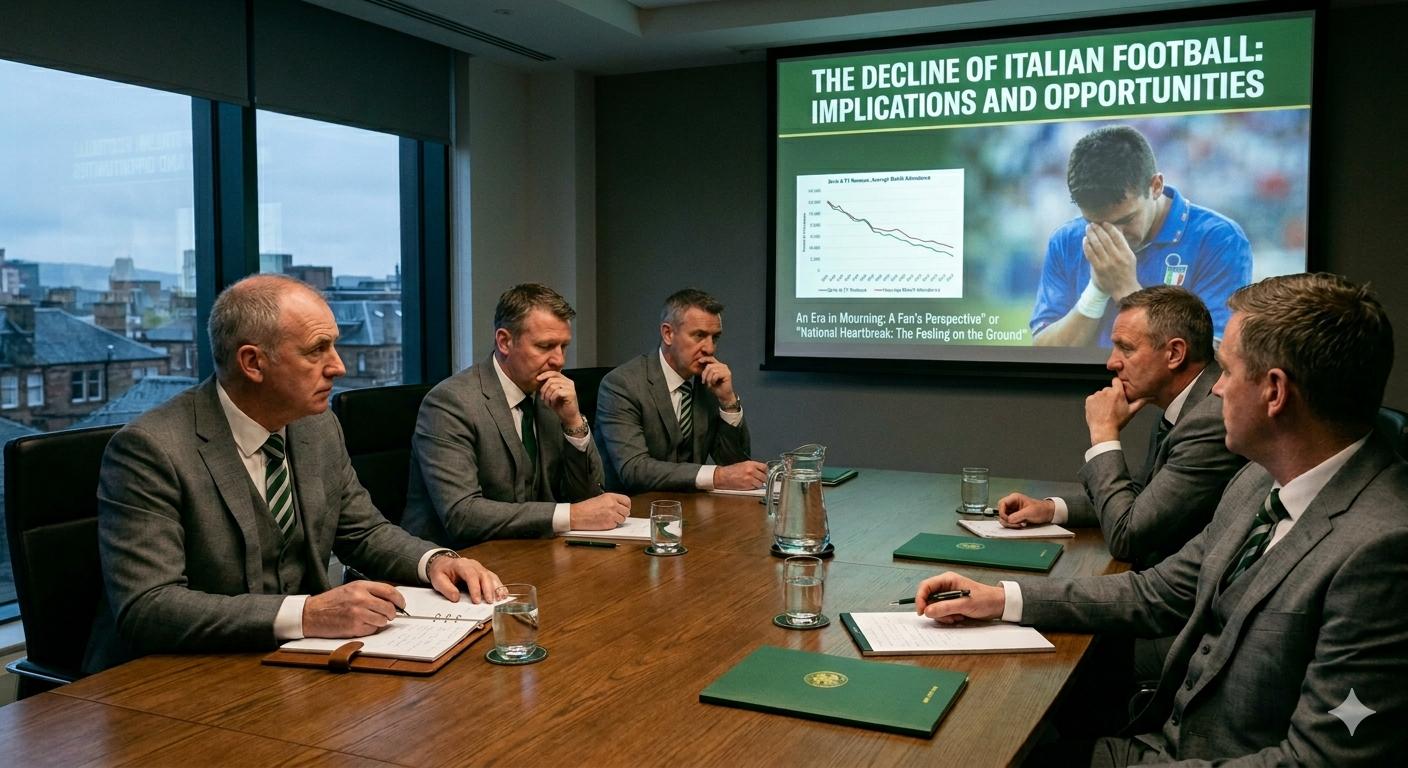
However, having now failed to Qualify for USA 2026, and having failed to reach Russia 2018 and Qatar 2022, Italy are the first former winners to miss out on three consecutive World Cups.
Preventing The Decline – The Divine Ponytail
Following Italy’s disastrous 2010 World Cup campaign in South Africa, where the defending champions crashed out in the group stage, the Italian Federation sought to rebuild its image and structure.
In August 2010, the federation appointed Roberto Baggio as the President of the Technical Sector. Effectively the technical director. His primary mission was to reinvigorate the Italian game, modernise coach training, and reverse the country’s poor track record of developing and blooding young talent.
The 900-Page Report
Unlike many ex-players who take on ambassadorial or figurehead roles, Baggio took his responsibilities incredibly seriously. He spent over a year analysing the deep-rooted issues in Italian youth development, scouting, and coaching philosophies.
In December 2011, he presented a comprehensive, 900-page master plan to the Federation.
Frustration and Resignation
Despite the effort and depth put into the project, Baggio’s report was completely ignored by the Federation hierarchy. He was given no budget to implement his ideas and was locked out of actual decision-making.
Frustrated by being treated as a mere figurehead, Baggio announced his resignation in January 2013.
In his public statement, he famously remarked to Italian television:
“I presented my project in December 2011, 900 pages, but they remained empty words. I don’t like just sitting on a chair but to do things, therefore reluctantly I have decided to leave.”
The Aftermath and Legacy
In hindsight, many football experts and fans view Baggio’s ignored report as a prophetic warning.
In the years following his departure, the Italian national team has suffered a historic decline. Baggio’s project is frequently cited by critics of the Italian Federation as the exact blueprint Italy needed, and then actively ignored.
Celtic Relevance
Celtic have been undeniably dominant since the year 2000. The demise of their biggest rival was a massive contributing factor to this. However, with Scottish Football becoming a one horse race, this led to unforeseen consequences.
Peter Lawwell, the former CEO, became unduly risk averse and insular. With all the vision of an accountant, he failed to view the death of Rangers in 2012 as an opportunity for advancement. Seeing only the need for entrenchment.
With the vague hope of ever moving leagues to play in England a distant memory, the decision was taken to double down on domestic dominance.
The complacency that embedded itself in a back slapping boardroom during this period, laid the groundwork for our situation today.
Venality Before Vision
The failure to focus on European advancement is at the heart of our current regression. A Celtic squad built to compete at the top levels of Europe would be domestically dominant by default.
This is before you consider the magnitude of proposals which would see seismic shifts in the European game, and which have not yet gone away.
Celtic must be as close to the elite as possible when inevitable future decisions are made on the reorganisation of European football.
Not being relevant in those conversations is a sure way of being excluded or ignored to what may not be just our detriment, but a potentially irreversible cycle of decline.
Celtic Solutions
The determination of the board to continue as they are, flies in the face of every valuable lesson from human and football history.
Ideally, we should have our own Baggio conduct an independent strategic review of every aspect of the club, from the ground up.
Not a half hearted Strachaneque effort to placate fans, which will never see the light of day.
Transparent, in depth and fearless, with published results. The board should act on the proposals immediately, unlike the Italian Federation, who now face generational consequences for sitting on their hands and denying reality, rather than facing the discomfort and challenge of change.
For full fan engagement we wouldn’t even need the entire business plan, but we would need clarity on objectives, strategy and goals. Despite what the board currently believes, we turn to our team for inspiration and joy, not more of the drudgery and grind of daily life.
Minimum Requirements
At the very least must come the realisation for the board that, no matter how dominant we have been, success cannot continue in the face of opposition to change. Running to stand still is a sure way of being left behind.
Rodgers referred to it as maintenance.
The once enviable, glamorous and glorious Italian football, is an abject lesson in what happens when you convince yourself past performance guarantees future success.
Intransigence in the face of clear evidence. Fear rather than foresight. Complacency and comfort rather than creativity and courage
Our board must demonstrate the determination and desire to deviate from managed decline.
Celtic must adapt and evolve to survive and thrive.
Evolution spells out what happens to those who fail to do so.


Leave a Reply